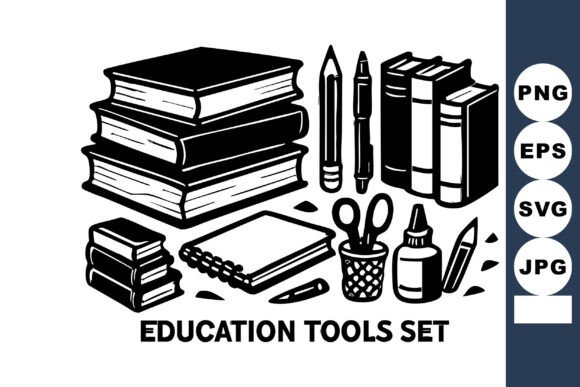
Education Tools Set with Books Pencils S: A Practical Asset for Professional Workflows
In the landscape of digital design and content creation, the ability to convey complex ideas through simple, universally recognized imagery is a critical skill. The Education Tools Set with Books Pencils S serves as a foundational asset for professionals who need to communicate themes of learning, preparation, and academic structure without relying on photography or custom illustration. This specific vector collection, characterized by its black and white aesthetic, offers more than just decorative elements; it provides a structured visual language that fits seamlessly into planning documents, marketing materials, and educational resources.
For adults managing projects in education, publishing, or corporate training, the integration of high-quality vector graphics is not merely an aesthetic choice but a functional necessity. It ensures consistency across various media formats, from print brochures to responsive web interfaces. By utilizing a set like this, creators can maintain a professional tone while reducing the time spent sourcing disparate assets. The focus here is on practical implementation: how to take these raw digital files and transform them into effective communication tools within a real-world workflow.
The Role of Vector Assets in Project Planning
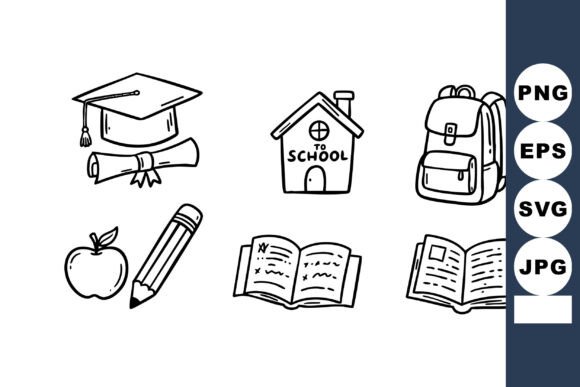
Before a single line of copy is written or a layout is finalized, the planning phase requires visual anchors to define the scope and mood of a project. The Education Tools Set with Books Pencils S acts as one such anchor. When educators are designing a curriculum guide, or when marketers are pitching an e-learning platform, the immediate visual association with books, pencils, scissors, glue, and notebooks establishes context instantly.
This clarity is essential during the early stages of decision-making. Stakeholders often struggle to visualize abstract concepts until they see them represented concretely. A black and white vector image strips away the distraction of color, forcing the viewer to focus on the composition and the objects themselves. This simplicity aligns with the "educational and practical mood" required for serious business communications. It signals that the content is grounded, organized, and ready for use.
Integrating these assets early in the process allows teams to create wireframes and mockups that are closer to the final product. Instead of using placeholder boxes or low-resolution stock photos, designers can utilize the scalable nature of SVG and EPS files to test different layouts. This reduces friction between the concept phase and the execution phase, ensuring that the visual identity remains consistent as the project evolves.
Pre-Production Considerations and File Compatibility
A critical aspect of working with any digital asset library is understanding the file formats provided. The downloadable ZIP for this set includes SVG, EPS, JPG, and PNG files, each serving a distinct purpose in a professional workflow. Understanding when to deploy each format is a key component of efficient resource management.
- SVG (Scalable Vector Graphics): Ideal for web applications and responsive design. Because SVGs are code-based, they scale infinitely without losing quality, making them perfect for icons, logos, and illustrations that must render sharply on high-resolution mobile screens.
- EPS (Encapsulated PostScript): The standard for print production. If your workflow involves sending files to a commercial printer for brochures, posters, or textbooks, the EPS file ensures that the lines remain crisp and editable within vector software like Adobe Illustrator.
- PNG (Portable Network Graphics): Best for quick integration into presentations, social media graphics, or web banners where transparency is required but interactivity is not. These rasterized versions offer speed at the cost of scalability.
- JPG (Joint Photographic Experts Group): Useful for email attachments or contexts where file size is a primary constraint, though less ideal for high-end print due to compression artifacts.
By having all these formats available, the Education Tools Set with Books Pencils S eliminates the bottleneck of file conversion. Professionals can move directly from selection to implementation, saving valuable time during tight deadlines. This versatility supports a streamlined workflow where the technical requirements of the output medium dictate the file choice, rather than forcing the designer to compromise on quality.
Implementing Visual Consistency Across Channels
Consistency is the hallmark of a mature brand or educational program. Whether you are a freelancer creating a portfolio, a small business owner launching a workshop series, or an institution updating its internal documentation, maintaining a cohesive visual style is challenging. The black and white vector style of this toolset offers a neutral palette that adapts easily to existing brand guidelines.
When used in conjunction with other design elements, these images provide a structural backbone. For example, in a slide deck for a teacher training session, the icons of scissors and glue can represent the "hands-on" portion of the curriculum, while the books symbolize theoretical knowledge. Because the design is simple and clear, these symbols do not compete with text-heavy slides. They act as visual cues that help the audience navigate the information flow.
Furthermore, the monochromatic nature of the assets allows for easy customization. While the base set is black and white, vector formats allow users to apply brand colors selectively. A marketer might keep the outlines black but fill the notebook icon with their company's primary blue. This flexibility ensures that the asset integrates smoothly without clashing with the overall design system. It supports a strategy of modular design, where core elements are reused and slightly modified to fit different contexts while retaining their core identity.
Workflow Integration for Educators and Content Creators
For those involved in the creation of educational materials, the Education Tools Set with Books Pencils S fits naturally into the content development lifecycle. During the drafting phase, these images can be used to storyboard lesson plans or module structures. Visualizing the sequence of learning activities becomes easier when paired with recognizable icons representing the necessary tools.
Consider a scenario where an instructional designer is mapping out a course on creative writing. The "books" icon can mark the reading modules, the "notebook" can signify journaling exercises, and the "scissors" could represent editing and cutting down drafts. This visual mapping aids in the cognitive organization of the material, helping both the creator and the end-user understand the progression of tasks.
After the content is finalized, these same assets serve as branding elements for certificates, completion badges, or promotional flyers. The transition from planning tool to marketing asset demonstrates the long-term value of investing in high-quality vector libraries. It reduces the need to commission new artwork for every stage of the project, thereby optimizing budget allocation and production timelines.
Quality Control and Long-Term Usability
In any professional environment, the longevity of digital assets is a concern. Trends change, and low-quality images quickly date a publication or website. The clean lines and timeless subject matter of the Education Tools Set with Books Pencils S ensure that these graphics remain relevant for years. Unlike photographic styles that may become outdated, the schematic representation of school supplies is a classic trope that transcends fleeting design trends.
Quality control also extends to the technical integrity of the files. When downloading a ZIP package containing multiple formats, it is prudent to verify the resolution and layer structure immediately. Checking the SVG code for unnecessary metadata or the EPS file for proper font embedding prevents issues downstream. Ensuring that the files are optimized for their intended use case is a small step that prevents significant headaches during the final delivery phase.
Additionally, organizing these assets within a team's shared drive or digital asset management (DAM) system is crucial for efficiency. Labeling the files clearly—distinguishing between the vector source files and the raster exports—ensures that any team member can locate the correct version for their specific task. This organizational discipline supports a collaborative workflow where everyone operates from the same version of the truth, minimizing errors and rework.
Strategic Application in Business and Personal Goals
Beyond the classroom, these tools have applications in broader business contexts. Entrepreneurs launching ed-tech startups can use these visuals to explain their product's functionality in pitch decks. The familiarity of the imagery lowers the barrier to entry for potential investors or clients who may not be tech-savvy. It translates a digital solution back into tangible, understandable terms.
For personal productivity and goal setting, the concept of "education tools" can be metaphorical. Using these images in personal planners or vision boards can reinforce a mindset of continuous learning and preparation. The visual reminder of pencils, notebooks, and books serves as a prompt to engage in study, planning, and creative work. It turns the abstract goal of "self-improvement" into a concrete visual routine.
Ultimately, the value of the Education Tools Set with Books Pencils S lies in its adaptability and reliability. It is a resource that supports the entire lifecycle of a project, from the initial spark of an idea to the final polished product. By prioritizing clarity, compatibility, and consistency, professionals can leverage these assets to enhance their communication, streamline their workflows, and deliver higher quality outcomes to their audiences. In a world saturated with complex information, the power of a simple, well-designed vector image cannot be overstated.